Detecting shifts in suicide discourse in 19th-century British news
Background
Public discourse around suicide underwent a significant shift in 19th-century Britain. This involved moving away from moral, religious and legal framings of suicide, i.e., as felo-de-se (self-murder, a sin and a crime) and, instead, towards a range of increasingly secular attitudes (see Gates 1995; York 2009). These included philosophical arguments in defence of personal autonomy, as well as emerging medical, psychological and environmental accounts, which shifted public discourse towards pathological and socio-economic understandings of the issue.Goal
In a pilot experiment with Daniel C. S. Wilson, our goal was to explore for the first time whether such a shift could be detected and quantified in large-scale historical newspaper data of the period.We approached the question from the framing of suicide as felo-de-se, as one of the earliest and most persistent framings of suicide in this period. Murder reports provided a meaningful point of comparison as the lemma murder itself arguably always encodes some kind of explicit legal, religious, or moral responsibility being placed on an individual.
Method
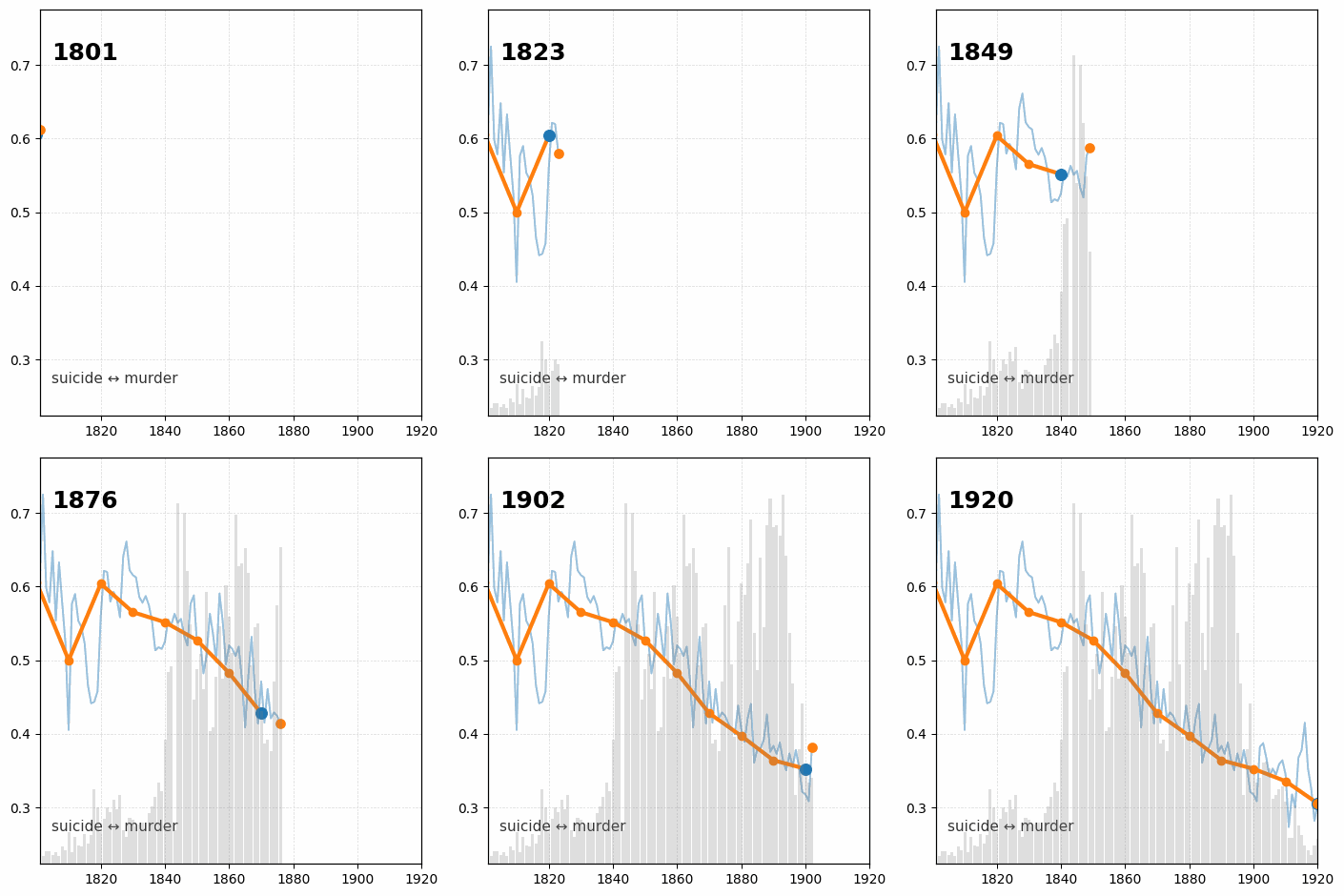
We first extracted newspaper articles mentioning suicid* (suicide, suicides, suicidal) and articles mentioning murder from the corpus. Articles were then represented by crudely mean-pooled contextual token embeddings extracted from a BERT model (NewsBERT) that we fine-tuned on 19th-century British newspaper data.For each suicide article, we identified its 100 nearest neighbours in the embedding space and measured how many of them were murder reports versus other suicide reports. If suicide is framed as self-murder, we expect the local neighbourhood to be dominated by murder reports. If suicide develops a more distinct and complex framing over time, that influence should weaken, so the neighbourhood should become progressively less murder-like.
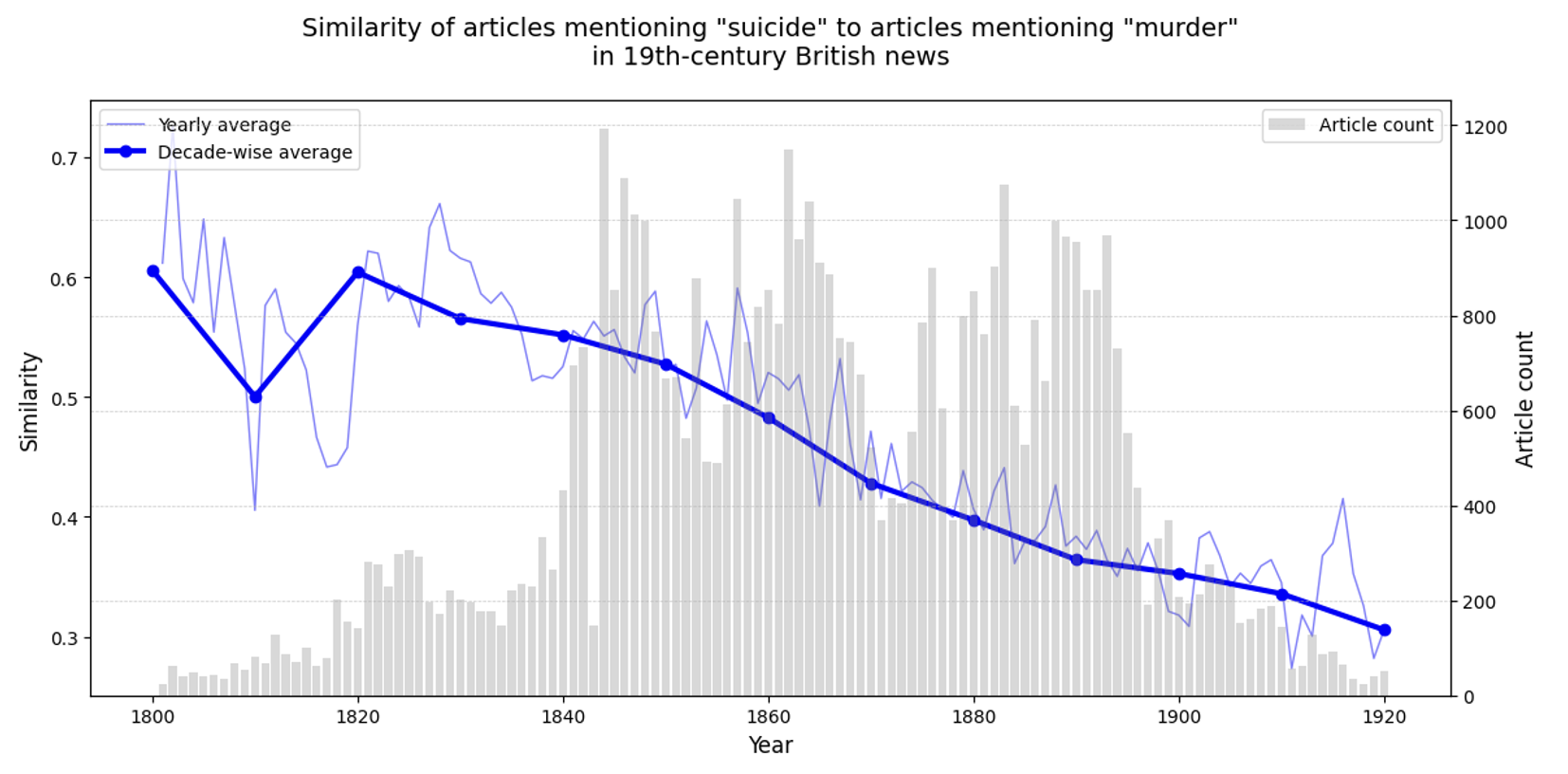
We finally averaged the murder ratio by year and plot the resulting time series. Results
The curve shows a clear and steady downward trend from 1800 to 1920, where suicide and murder articles gradually drift apart in the embedding space. This indicates a slow decoupling from religious, moral, and legal blame ('self-murder'), possibly reflecting a broader public shift towards medical and environmental understandings of suicide motives.The much higher number of articles (in grey in the Figure) in the middle and later decades of the century simply reflects a steady historical increase in newspaper production (cf. Beelen et al. 2022, 2025). Note how the downward trend holds consistently despite this imbalance, which suggests that our simple embedding-based method is relatively robust to such variation. Our proof of concept thus supports extending the approach to more representative and targeted sub-samples based on enriched metadata (cf. Westerling et al. 2025).
Resources
This experiment was a proof of concept made possible by newly released open historical newspaper collections:The models, code and data used in the experiment are also openly available:- Scripts and notebooks: github.com/npedrazzini/BlameGame
- Models, datasets and outputs (including NewsBERT): huggingface.co/collections/npedrazzini/blamegame
Credits
This work was developed as part of the Living with Machines and Data/Culture projects.References
B. T. Gates. 1995. Victorian suicide: Mad crimes and sad histories. Princeton: Princeton University Press.
S. H. York. 2009. Suicide, lunacy and the asylum in nineteenth-century England. University of Birmingham PhD Thesis.
K. Westerling, K. Beelen, T. Hobson, K. McDonough, N. Pedrazzini, D. C. S. Wilson & R. Ahnert. 2025. LwMDB: Open metadata for digitised historical newspapers from British Library collections. Journal of Open Humanities Data 11, Article 32.
T. Hobson, K. Westerling, K. McDonough, D. C. S. Wilson, N. Pedrazzini & K. Beelen. 2024. LwMDB simplified exports [Dataset]. Zenodo.
Beelen, Kaspar, Jon Lawrence, Katherine McDonough & Daniel C. S. Wilson. 2025. Whose News? Critical methods for assessing bias in large historical datasets. Computational Humanities Research 1–21. https://doi.org/10.1017/chr.2025.10007.
Beelen, Kaspar, Jon Lawrence, Daniel C. S. Wilson & David Beavan. 2022. Bias and repre- sentativeness in digitized newspaper collections: Introducing the environmental scan. Digital Scholarship in the Humanities 38(1). 1–22. https://doi.org/10.1093/llc/fqac037.
Check out other projects